

Facing Federal Criminal Charges?
The Federal System Is Different. So Is Carlo's Defense.
Federal criminal cases are among the most complex and high-stakes matters in American law. The conviction rate in federal court exceeds 90%. Mandatory minimum sentences and the Federal Sentencing Guidelines routinely mean years — or decades — in federal prison. Tyler Texas Criminal Defense Lawyer Carlo D'Angelo has filed petitions before the U.S. Supreme Court, tried federal cases nationwide, and testified before the U.S. Treasury on federal financial crime. He knows the federal system — and how to fight it.
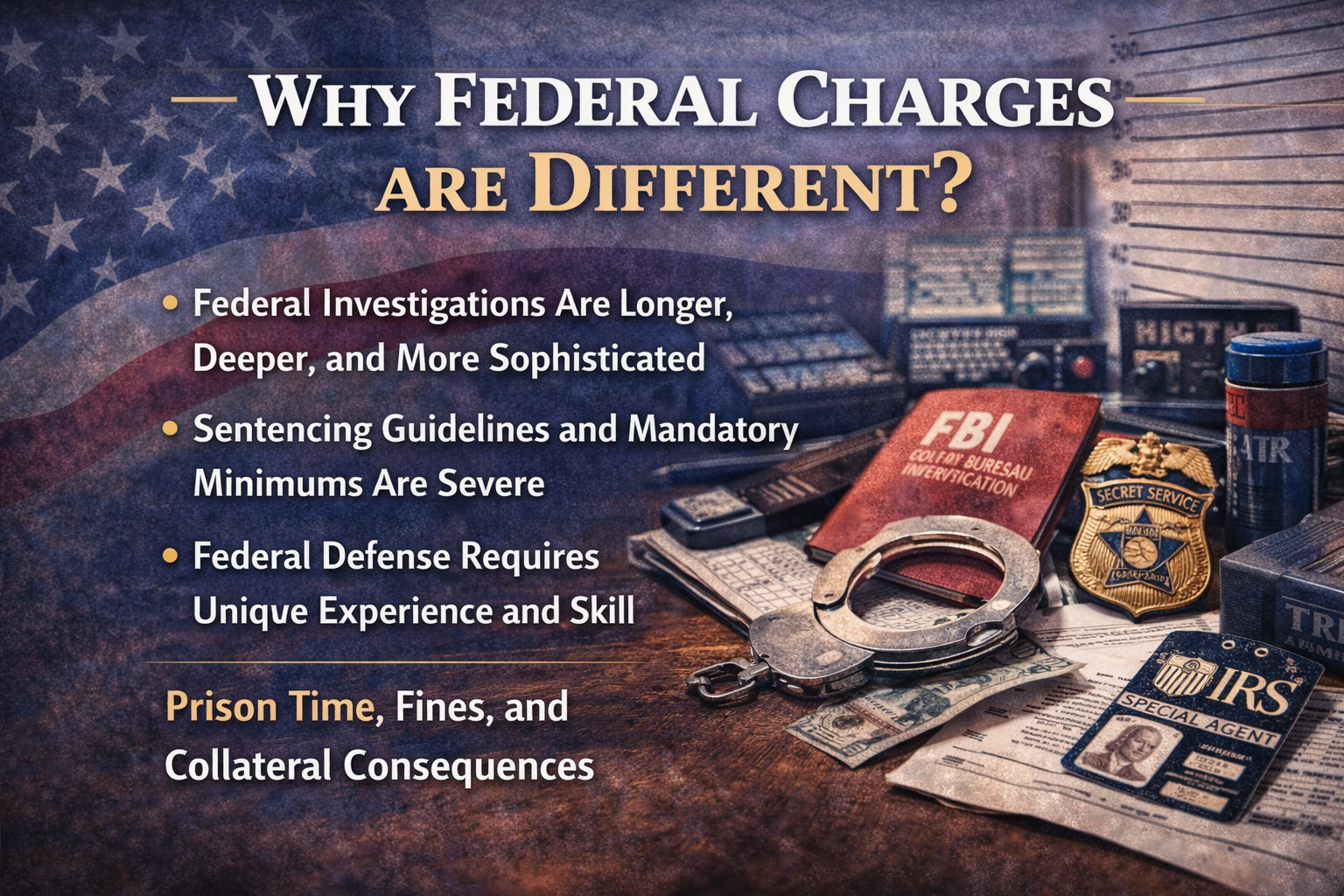
Why Federal Charges Are Different?
When the federal government comes for you, it comes prepared. Federal investigations — led by the FBI, DEA, ATF, IRS, Secret Service, or HSI — typically span months or years before an arrest is ever made. By the time you are indicted, the government has wiretaps, cooperating witnesses, financial records, and digital evidence assembled into a case designed to convict.
The federal rules of criminal procedure, the Federal Sentencing Guidelines, and the mechanics of grand jury proceedings require defense counsel with specific federal experience. Attorneys who practice exclusively in state court are at a significant disadvantage in the federal system. Carlo D'Angelo has practiced in federal courts across the country and brings genuine federal trial experience to every case he defends.
Federal charges Carlo defends include: drug trafficking and conspiracy, wire fraud and bank fraud, tax fraud, healthcare fraud, money laundering, firearm offenses, cybercrime, cryptocurrency crime, sex trafficking, and public corruption.
The Federal Sentencing Guidelines
Unlike state courts, federal judges sentence defendants according to the Federal Sentencing Guidelines — a complex scoring system that calculates a recommended sentence range based on the offense level and the defendant's criminal history. The Guidelines consider the type of offense, quantities involved, number of victims, role in the offense, and dozens of other factors. A single enhancement can add years to a sentence.
Mandatory Minimums
Many federal statutes — particularly drug, firearm, and sex crime statutes — carry mandatory minimum sentences that remove judicial discretion entirely. A federal judge cannot sentence below the mandatory minimum regardless of the circumstances. Congress sets these floors, and only a limited number of exceptions (the safety valve, substantial assistance) allow departure below them.
The Trial Penalty
The gap between the sentence offered in a plea and the sentence after a federal trial conviction is known as the trial penalty. Federal defendants who go to trial and lose often receive sentences two to three times longer than the plea offer. This pressure is real — and it is exactly why having a credible, experienced federal trial attorney matters. Prosecutors make better deals when they know your attorney can and will go to trial.
• Federal prison sentences are served at 85% (no parole in the federal system)
• Fines, restitution, and forfeiture can reach millions of dollars
• Supervised release follows imprisonment — often for years
• Collateral consequences: loss of voting rights, firearm rights, immigration consequences, professional license revocation
Federal Criminal Defense in the Eastern District of Texas
If you are charged with a federal crime in East Texas, your case will most likely be prosecuted in the U.S. District Court for the Eastern District of Texas — one of the busier federal districts in the country. The district spans 43 counties and is organized into divisions including Tyler, Sherman, Plano, Beaumont, Marshall, Texarkana, and Lufkin. Where your case is heard affects which U.S. Attorney's Office prosecutes it, which magistrate and district judges preside, and the practical rhythms of how cases move.
Carlo D'Angelo regularly defends federal cases in the Eastern District and has tried federal cases nationwide. He knows the local federal landscape — the prosecutors, the detention practices before the magistrate judges in Tyler, and the way the Fifth Circuit's precedent shapes what is and isn't worth litigating here. Federal defense is a national discipline, but it is practiced in a specific courthouse in front of specific people, and that local knowledge matters.
If your investigation is being run by a federal agency — the FBI, DEA, ATF, IRS, Secret Service, or HSI — operating in East Texas, the case will run through this district. The earlier experienced local federal counsel is involved, the more can be done.
Carlo's Federal Defense Strategy
Engaging at the Investigation Stage
Many federal cases can be shaped — or stopped — before indictment. If you know you are under federal investigation, Carlo can engage with the prosecution early, contest the government's theory, present exculpatory evidence, and in some cases prevent charges from ever being filed. The worst time to hire a federal defense attorney is after indictment. The best time is now.
Grand Jury Strategy
Federal indictments are returned by grand juries. While a target has no right to testify before a grand jury, witnesses do appear — and how those witnesses are counseled can determine the direction of the entire case. Carlo advises clients and witnesses on grand jury appearances and evaluates whether target letters warrant a proactive defense strategy.
Challenging the Government's Evidence
Federal cases are evidence-intensive. Carlo conducts thorough pretrial motions practice — suppression of unlawfully obtained evidence, challenges to wiretap orders, Daubert motions to exclude unreliable expert testimony, and Brady motions to compel disclosure of exculpatory material.
Sentencing Advocacy
Even in cases where conviction is likely or certain, aggressive sentencing advocacy can mean the difference between five years and fifteen. Carlo prepares comprehensive sentencing memoranda, retains mitigation experts, challenges the government's Guidelines calculations, and argues for every available departure and variance.
Appeals and Post-Conviction Relief
Carlo handles federal criminal appeals to the Fifth Circuit Court of Appeals and petitions to the U.S. Supreme Court. He also handles § 2255 motions for post-conviction relief in cases involving ineffective assistance of counsel or newly discovered evidence.
Frequently Ask
Why Carlo D'Angelo for a Federal Case
Federal defense rewards specific, demonstrable experience. Carlo D'Angelo has tried federal cases to verdict — including a four-count federal indictment in the Eastern District of Texas that ended in a "Not Guilty" verdict on all counts. He has filed petitions before the U.S. Supreme Court, testified before the U.S. Treasury on federal financial crime, and published legal scholarship that informs how he argues. After 28 years, he brings genuine federal trial experience — not just state-court experience applied to a federal courtroom — to every case he defends.
Frequently Asked Questions About Federal Criminal Defense Crimes
Q: I received a federal target letter. What should I do?
Call a federal defense attorney immediately — do not contact the investigating agents, do not speak to prosecutors without counsel, and do not destroy documents. A target letter means the grand jury has identified you as a likely subject of indictment. This is not the time to wait and see. It is the time to act.
Q: Is it possible to beat a federal case at trial?
Yes — though federal acquittals require extraordinary preparation and the willingness to take the government's case apart piece by piece. Carlo has tried and won federal cases. The key is having an attorney who has genuinely done it, not one who hopes to.
Q: What is the difference between a target, a subject, and a witness in a federal investigation?
A target is someone the grand jury has substantial evidence against — indictment is likely. A subject is someone whose conduct is within the scope of the investigation but against whom evidence is less developed. A witness has information relevant to the investigation but is not currently in the government's crosshairs. All three categories require legal counsel — your status can change rapidly.
Q: Can a federal sentence be appealed?
Yes. Federal sentences can be appealed to the Fifth Circuit on procedural and substantive reasonableness grounds, and for legal errors at trial. Post-conviction relief through 28 U.S.C. § 2255 is also available for constitutional violations, including ineffective assistance of counsel.
Q: Do I need a local attorney for a federal case in Texas?
Federal courts operate under federal rules, but local knowledge matters — local rules, judicial preferences, and relationships with the U.S. Attorney's Office are real factors in how cases unfold. Carlo practices in the Eastern District of Texas and federal courts nationwide, combining true federal experience with East Texas roots.
What's the difference between a federal and a state criminal charge?
Federal charges are prosecuted in federal court under federal law by U.S. Attorneys, typically after long investigations by agencies like the FBI, DEA, ATF, or IRS. They carry mandatory minimum sentences and are governed by the Federal Sentencing Guidelines. Federal sentences are served at 85% with no parole, and are generally longer and harder to reduce than state sentences for comparable conduct.
Can a federal case be stopped before charges are filed? Sometimes. Many federal cases can be shaped — or occasionally prevented — at the investigation stage, before indictment. If you know you're under federal investigation or have received a target letter, early engagement by experienced counsel can contest the government's theory and present exculpatory evidence. The best time to hire a federal defense attorney is before charges are filed, not after.
What is the "trial penalty" in federal court? It's the gap between the sentence offered in a plea and the sentence imposed after a trial conviction. Federal defendants who go to trial and lose often receive sentences two to three times longer than the plea offer. Having an attorney who can credibly take a case to trial is part of what produces better plea outcomes.
What are mandatory minimum sentences? Many federal drug, firearm, and sex-offense statutes set a minimum sentence that a judge cannot go below, regardless of the circumstances. Only limited exceptions — the safety valve and substantial assistance to the government — allow a sentence below the mandatory minimum.
Does Carlo handle federal appeals? Yes. Carlo handles federal criminal appeals to the Fifth Circuit Court of Appeals, petitions to the U.S. Supreme Court, and § 2255 motions for post-conviction relief in cases involving ineffective assistance of counsel or newly discovered evidence.