

The Cops Want Rules. Sen. Warren Wants the Bill Dead. What That Tells Us
When the organization that speaks for 382,000 police officers tells the Senate that the answer to crypto crime is a statute—and the loudest self-described consumer advocate in Congress says the bill should be dead on arrival—one of those positions is about protecting victims and the other one is not.
To be CLEAR, ambiguity has never once protected a consumer. It just decides, after the fact, who gets charged.
On April 21, 2026, the National Fraternal Order of Police told the Senate Banking Committee it was “strongly opposed” to the developer safe harbor buried in the CLARITY Act. Three months later—on July 24, 2026—the same organization, over the same signature, wrote the same two senators to say its concerns had been “satisfactorily addressed” and that it looks forward to getting the bill passed.
That reversal is worth more than a news cycle. It is the clearest signal yet that the people who investigate digital asset crime have concluded what many crypto lawyers have been arguing for years: legal ambiguity is not a law enforcement advantage. It is a liability for everyone in the courtroom.
What the FOP Letter Actually Says
The July 24 letter from National President Patrick Yoes to Chairman Tim Scott and Ranking Member Elizabeth Warren is a short document, but it does a lot of work. Stripped to its essentials:
1. The developer safe harbor fight is over. The FOP’s original objection was to the Blockchain Regulatory Certainty Act provisions folded into CLARITY—the language establishing that a non-controlling developer or infrastructure provider, someone with no legal right or unilateral ability to move a user’s assets, is not thereby a money transmitter. The FOP had warned this would strip prosecutors of leverage. The revised text, according to the letter, includes “clarifying language” confirming the provision does not limit the ability of law enforcement and prosecutors to address unlawful conduct.
2. Section 1960 survives—explicitly. The letter singles out 18 U.S.C. § 1960 by name. The FOP is satisfied because the bill “explicitly preserves” liability for those who act with intent to transfer funds known to be criminal proceeds or intended to promote unlawful activity. In plain English: the § 1960(b)(1)(C) theory—unlicensed money transmitting involving funds known to be derived from or intended to promote crime—is untouched.
3. The bill hands state and local police new capacity. Title IX of the current version reportedly creates a grant program for state and local digital asset enforcement, a national training program, a digital asset cyber innovation center, and provisions aimed at protecting elderly victims from fraud.
4. Transaction holds get a liability shield. Exchanges and stablecoin issuers would be protected from liability when they voluntarily delay suspicious transactions or act at law enforcement’s request—what the FOP frames as buying investigators “critical time.”
5. Digital assets move under Bank Secrecy Act monetary instrument authorities, with new obligations around kiosks, information sharing, and international AML and sanctions coordination.
Yoes closes by thanking the senators on behalf of the FOP’s 382,000 members. The organization that was the loudest law enforcement holdout is now a supporter. Why This Matters to Anyone Facing a Crypto Investigation
There is a comfortable assumption in some corners of the industry that prosecutors like vague law—that ambiguity is a prosecutorial weapon and clarity is purely a defense win. The FOP letter punctures that.
Ambiguity is expensive on both sides. A prosecutor who cannot tell a grand jury with confidence whether a given asset is a security or a commodity, whether a given service is a money transmitting business, or whether a given wallet developer had any regulatory duty at all, is a prosecutor building a case on sand. Investigations stall. Charging decisions get pushed to the most aggressive available theory because the narrow theories are untested. Juries get instructions nobody is happy with. And appellate courts start unwinding convictions on fair notice grounds years later.
The FOP looked at that landscape and decided a defined statutory perimeter—even one that expressly protects a class of developers it had spent months objecting to—beats the status quo.
The Objection That Can’t Be Satisfied
Which raises the obvious question. If the cops are satisfied, who is still fighting, and what are they actually fighting for?
There are three postures available toward a bill like this. Pass it. Fix it. Kill it. Only the third one leaves us where we are.
Almost everyone in this fight is in the “fix it” camp—including even the banks. The most sustained, best-funded lobbying campaign against parts of this bill came from the American Bankers Association, the Bank Policy Institute, the Independent Community Bankers of America and their allies, and they fought hard. But read what they were asking for: tighter statutory guardrails on stablecoin yield in Section 404, out of fear of deposit flight. In July the ABA and ICBA came back with 76 state associations attached, urging the Senate to strengthen the language. That is not opposition to regulation. That is a fight over the terms of a statute they expect to live under—and Goldman Sachs’ CEO went further this week and endorsed the bill outright as imperfect but necessary.
The seven Senate Democrats who have been negotiating this for a year are in the same camp. Their joint statement this week said the current text falls short on ethics, consumer protection, and illicit finance—and then said they would keep working in good faith to get it over the finish line. Senator Alsobrooks wants state attorneys general empowered to enforce the ethics provisions rather than leaving it to this DOJ. Those are objections with a stated remedy. They can be met, and the people making them have said what would meet them.
That is also what the FOP did. Specific objection, written down, tied to a provision, withdrawn when the provision changed.
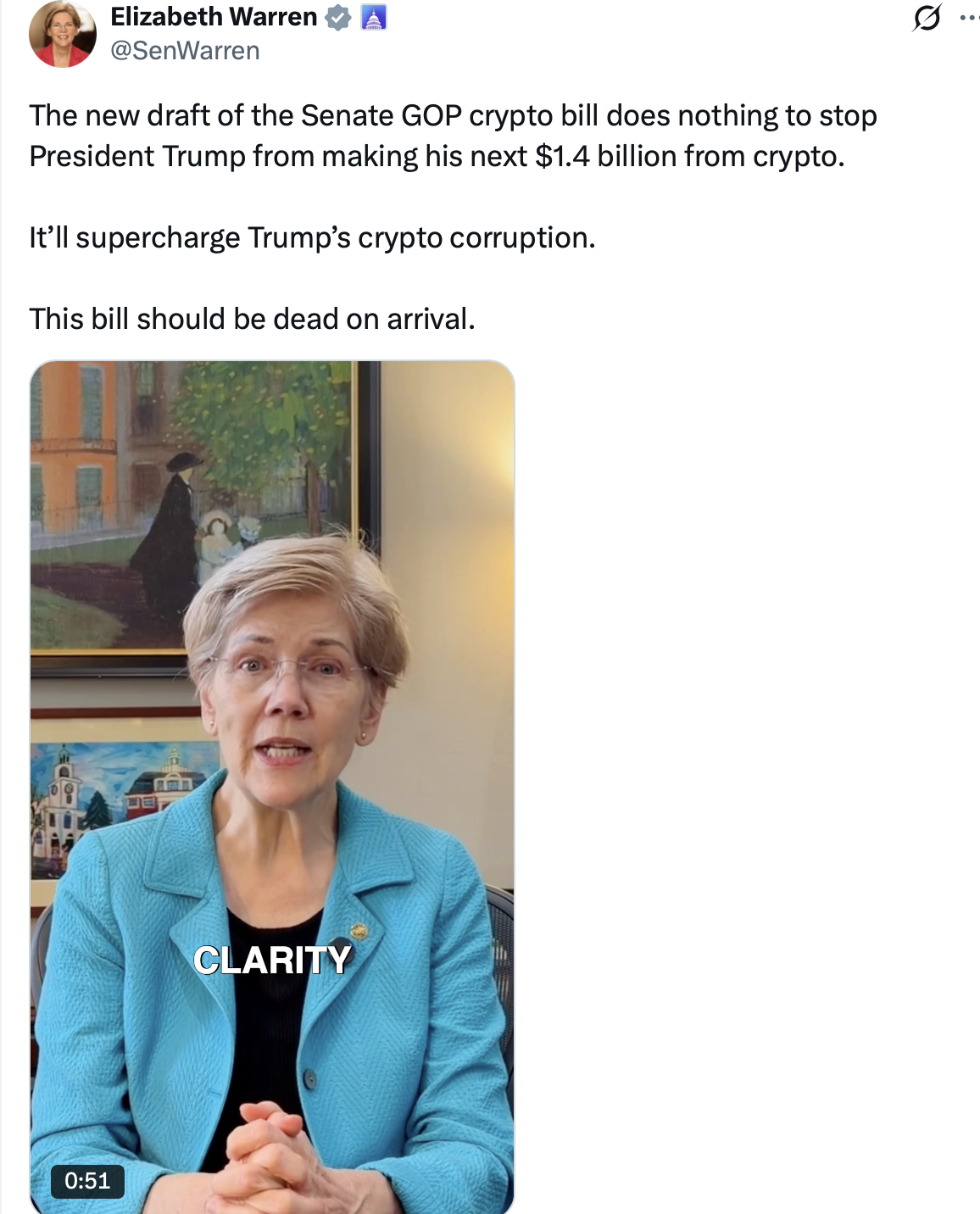
“Dead on arrival” is a different kind of statement. On July 22, Senator Warren said of the revised bill: ”This bill should be dead on arrival.” Not amend it. Not here is what would earn my vote. Kill it.
That is not a negotiating position. It is a preference for the status quo—and the status quo is precisely the condition of legal ambiguity that the national police union just told the Senate Banking Committee is hurting its officers’ ability to protect victims.
Both Things Cannot Be True
Here is the collision, and it happened within 48 hours in the same committee’s inbox.
In the video accompanying that statement, Warren argued the draft would make it easier for criminals, cartels, and terrorists to move money and finance their operations.
Two days later, the National President of an organization representing 382,000 sworn officers wrote to that same committee to say the revised bill gives law enforcement stronger investigative tools, clearer compliance pathways, and improved coordination to address exactly those threats—grants and training for state and local digital asset investigators, a cyber innovation center, BSA monetary instrument treatment for digital assets, kiosk fraud safeguards, protections for aging retirees, international AML and sanctions cooperation, and the express preservation of 18 U.S.C. § 1960 liability for anyone who knowingly moves criminal proceeds.
Both propositions cannot be true. Either this bill hands criminals a gift, or it hands investigators a toolkit. The people who actually run down these cases have now filed their answer in writing.
What “Dead on Arrival” Actually Delivers
This is the part that does not get said clearly enough, so let me say it plainly.
Killing this bill does not produce a better bill. There is no competing market structure framework pending. There is no Warren alternative that a developer, an exchange operator, a compliance officer, or a defendant could read tomorrow to determine what the law requires. Voting it down produces exactly one outcome: the framework we have today, continued indefinitely.
And every consumer protection in the bill dies with it. No statutory regime for crypto kiosks, which are a documented elder fraud vector. No dedicated law enforcement contact required at each operator, so investigators keep working the general customer service queue while the money moves. No grant program putting tracing capability in the hands of the county detective who catches the pig-butchering complaint. No training program. No statutory safe harbor letting an exchange pause a suspicious transfer long enough for a warrant to issue. No BSA monetary instrument treatment. No mandated information sharing on illicit finance risk.
Ask who absorbs that. It is not the sophisticated trader, who has counsel and jurisdictional options. It is the retiree who wires her savings into a kiosk at the direction of someone impersonating a federal agent, and then discovers that the responding officer has no training, no tracing tool, no statutory contact at the operator, and no mechanism to freeze anything before the funds are gone. That is the world “dead on arrival” preserves. It is the world the FOP is asking Congress to end.
You cannot claim the consumer protection mantle while opposing the only vehicle carrying consumer protections and offering nothing in its place. At that point the position is not protection. It is prohibition by attrition—a bet that if the rules never arrive, the industry eventually leaves. The problem with that bet is that the industry does not leave. It moves offshore, out of reach of American subpoenas, American courts, and the American officers who have to answer the victim’s call.
The Takeaway
The Fraternal Order of Police did not become pro-crypto. It negotiated for enforcement tools and got them, and in exchange it dropped its objection to a rule that protects people who write code but never touch anyone’s money.
Everyone else in this fight has been negotiating over terms—the banks over yield, the Democratic negotiators over ethics enforcement, the FOP over Section 1960 and Title IX. Terms can be met. “Dead on arrival” cannot, because it is not a request for anything.
So assume it works. Assume the bill stalls before the recess, the fall calendar swallows it, and the 119th Congress ends without a digital asset framework. What actually happens next?
Nothing pauses. That is the part the “dead on arrival” position never accounts for. The transactions still clear. The kiosks still take deposits from people who were told to make them by someone claiming to be a federal agent. The wallets still get built. The indictments still come.
The questions Congress declined to answer do not go unanswered—they get answered anyway, retroactively, one defendant at a time. Whether a developer is a money transmitter gets decided by a prosecutor picking a theory and a district judge ruling on a motion to dismiss. Whether a token is a security gets decided by whichever agency files first. Whether a “voluntary” account freeze was really a seizure gets decided three years later by a panel that has never opened a wallet. The venue simply moves from a committee room to a courtroom, and the party who absorbs the uncertainty stops being an industry and becomes a person with a name, a family, and a sentencing exposure calculated under guidelines written for a different technology.
Congress can resolve these questions prospectively, in public, with hearings and votes and text that anyone can read before they act. Or it can leave them to be resolved the slow way, in the dark, at the expense of whoever happened to be standing there when the government picked its theory. The Fraternal Order of Police has now said, in writing and against its own prior position, which of those it prefers. That should count for something.
Frequently Asked Questions
Is the CLARITY Act law?
No. H.R. 3633 passed the House in July 2025 and was reported out of the Senate Banking Committee on June 1, 2026. Senate Republicans released revised text on July 22, 2026. It still requires 60 votes on the Senate floor, reconciliation with the House-passed version, and a presidential signature. Until then, existing law governs.
Does the CLARITY Act mean crypto developers cannot be prosecuted?
No. The bill's developer provisions establish that a non-controlling developer — someone with no legal right or unilateral ability to move a user's assets — is not automatically a money transmitter on that basis alone. It does not create immunity. Liability is expressly preserved for anyone who acts with intent regarding criminal proceeds.
Would 18 U.S.C. § 1960 still apply to cryptocurrency cases?
Yes. Section 1960 is preserved, and the Fraternal Order of Police cited that preservation as a reason it dropped its opposition. The theory covering funds known to be derived from criminal activity or intended to promote unlawful activity remains fully available to prosecutors.
Why did the Fraternal Order of Police reverse its position on the bill?
The FOP opposed the developer safe harbor in April 2026, arguing it would limit prosecutions. After the bill was amended to clarify that the provision does not restrict law enforcement authority — and after enforcement funding, training programs, and Bank Secrecy Act provisions were added — the FOP wrote the Senate Banking Committee on July 24, 2026 stating its concerns had been satisfactorily addressed.
If the CLARITY Act passes, would it apply to conduct that already happened?
The framework is prospective. Conduct occurring before enactment would still be evaluated under existing law. That distinction can matter significantly to arguments about fair notice, vagueness, and the rule of lenity in cases involving pre-enactment activity.